 Asian
Osaka-Style Okonomiyaki
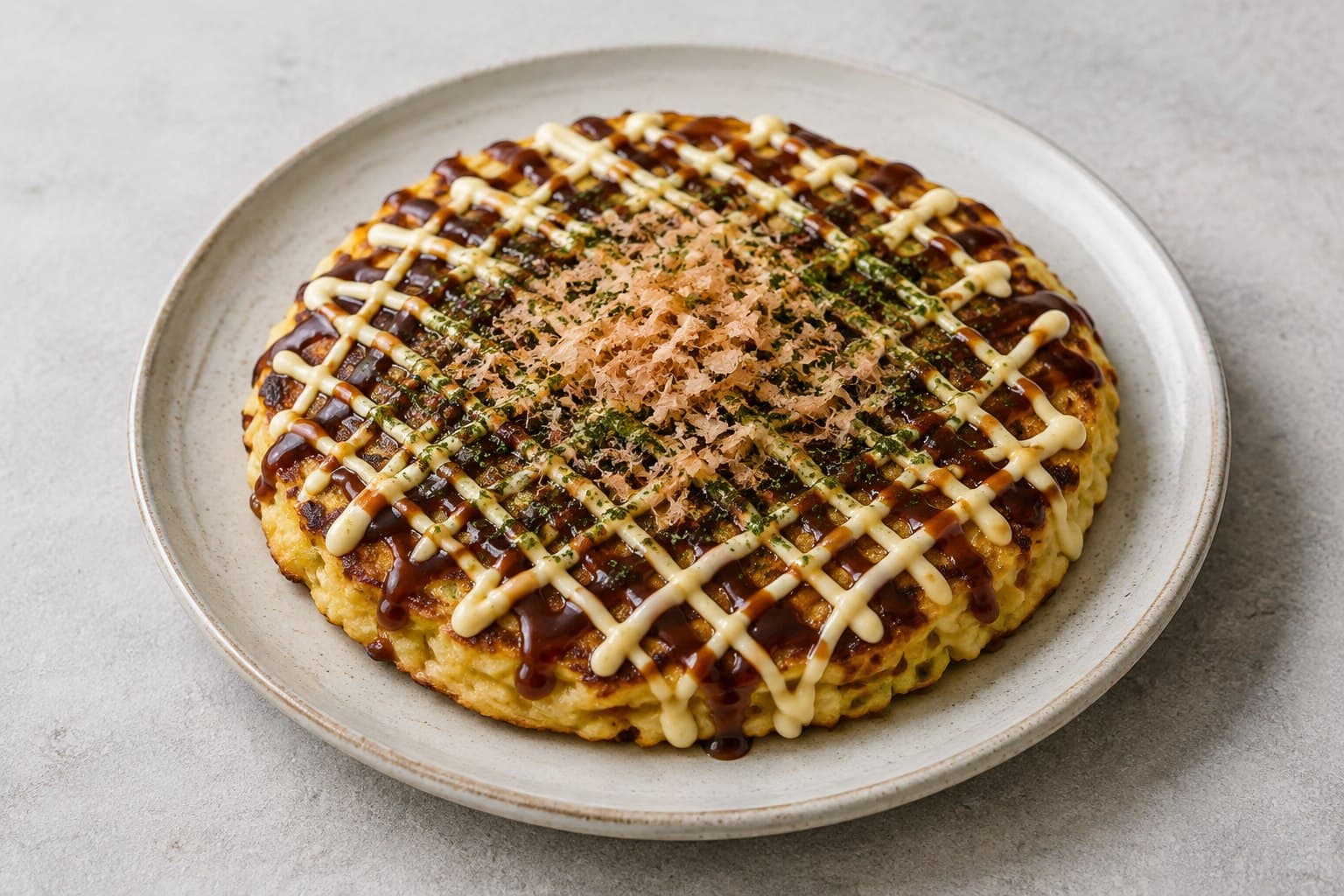
A thick Osaka-style cabbage pancake topped with thin slices of pork belly that crisp in the pan, finished with the classic sweet and savoury sauce, mayonnaise and bonito flakes.
- Prep:
- 15 minutes
- Cook:
- 40 minutes
- Waiting:
- 20 minutes (cooling the dashi, 20 minutes)
Method
Read the full method before starting. Cooking times are guides; check texture and doneness as you cook.
Shows the steps one at a time, with a timer for each timed step.
Heavy skillet, Sharp knife and board
Measure, cut, and arrange every ingredient in order of use. Read the full method and keep finishing ingredients separate.
- 01
Dashi
31 minutesMedium heatHeat the water with the kombu over medium heat until just below a boil, about 8 minutes, and remove the kombu. Add the bonito flakes for 1 minute, rest for 2 minutes, strain and chill for 20 minutes.
Success cueThe dashi is clear, pale gold and cold.
- 02
Batter
2 minutesWhisk the flour with the cold dashi and the eggs until just combined.
Success cueA few small lumps remain.
- 03
Filling
10 minutesSlice the cabbage into thin short ribbons and dry it well, then fold the cabbage and scallions into the batter.
Success cueThe cabbage is coated, with no pools of batter.
- 04
Shaping
1 minuteMedium heatHeat half of the oil in a nonstick pan over medium heat, spread half of the mixture into a round 2 cm thick without pressing it, and lay half of the pork belly slices on top.
Success cueThe round is even and holds its shape.
- 05
Cooking
11 minutesMedium heatCover for 5 minutes, flip with two spatulas so the pork is underneath and cook uncovered for 5 to 6 minutes, until the pork is crisp. Repeat with the rest of the oil, mixture and pork.
Success cueBoth sides are golden, the center is set and the pork is crisp and browned.
Watch outFlip in one quick move so the pancake does not break.
- 06
Finish
2 minutesBrush with okonomiyaki sauce, add thin lines of mayonnaise and sprinkle with aonori and bonito flakes.
Success cueThe bonito flakes move in the heat.
PlateMap is still in testing. Quantities and results may vary with ingredients and equipment. Please check food safety yourself, especially with meat and poultry.
Cooking tips
Cold dashi slows gluten development, keeping the interior tender while the outside browns.
- • Dry the cabbage well so the pancake is not watery.
- • Use two wide spatulas for a clean flip.
Common mistakes
- • Pressing the pancake down with the spatula, which makes it dense; it should stay fluffy inside.
- • Cutting the cabbage in long strips, which makes the pancake fall apart; short, thin ribbons hold together.
- • Cooking on high heat, so the outside burns before the centre sets.
Substitutions
- • Instead of dashi: water with a pinch of instant dashi, or plain water
Serving ideasServe hot on the pan or a board, cut into wedges, with pickled ginger on the side.
Estimated nutrition per serving
Calculated estimate per serving from the listed quantities. Product choice and retained cooking fat affect the result; this is not a laboratory analysis.
- Calories
- ≈ 665
- Protein
- 17.9g
- Carbs
- 49.1g
- Fat
- 44.4g
Calculation source and assumptions
Values use USDA data and linked product labels, adjusted for edible quantities and base servings. Brands, ingredient varieties, and cooking methods can change the result.
Egg, Wheat / gluten, Soy, Fish, Shellfish
Compound ingredients vary by product; check labels and possible cross-contact.
Frequently Asked Questions
What is the difference between Osaka and Hiroshima okonomiyaki?
In Osaka style, as here, the cabbage and fillings are mixed into the batter and cooked as one thick pancake. In Hiroshima style the batter, cabbage and noodles are layered on the griddle instead of mixed.
What can I use instead of okonomiyaki sauce?
Mix 3 tablespoons of ketchup, 2 of Worcestershire sauce, 1 of soy sauce and 1 teaspoon of sugar. It is close to the bottled sauce in taste and thickness.
Why is it called okonomiyaki?
Okonomi means 'as you like' and yaki means 'grilled'. Pork belly, as here, is the Osaka classic (butatama); shrimp, squid or cheese are just as common, and the halal version above the ingredients uses shrimp.
How do I know it is cooked inside?
After the second side, press the centre lightly: it should feel springy, not wet. A thin skewer pushed into the middle should come out clean.
You May Also Love